Real estate apps can look simple from the outside: listings, maps, filters, photos, messaging, and booking or transaction flows, but complexity starts behind the interface.
Property data comes from different sources. Search must stay fast across growing inventories. Maps, CRM systems, payments, analytics, and third-party services need to stay synchronized. Buyers, tenants, landlords, agents, and administrators often require different workflows inside the same product.
Custom real estate app development solves these challenges by designing architecture, integrations, and user journeys around the actual business model instead of forcing them into generic software.
Done well, a real estate platform becomes infrastructure for search, transactions, communication, operations, and data-driven decisions.
TL;DR
- Real estate app development should start with workflows, user roles, and data sources rather than a feature list.
- Custom development makes sense when search, marketplace logic, integrations, automation, or proprietary data create competitive advantage.
- Core capabilities often include listings, search, maps, user accounts, CRM workflows, messaging, analytics, and third-party integrations.
- Architecture should support growing listing volumes, geospatial search, real-time updates, permissions, and integration failures.
- Real estate mobile app development adds requirements around location services, notifications, performance, and device-specific UX.
- Existing platforms are often enough for standard workflows; custom real estate software solutions are more valuable when technology itself differentiates the business.
What Is Custom Real Estate App Development?
Custom real estate app development means building web or mobile software around specific property workflows, users, data sources, and business models.
Products may include property marketplaces, rental platforms, home-buying apps, property management systems, investment tools, agent software, booking platforms, or internal operations systems.
Generic real estate software solutions usually provide predefined workflows. Custom development gives businesses more control over search, integrations, transactions, data, automation, and future expansion.
UppLabs' PropTech Solutions cover marketplaces, property management, valuation, listing automation, tenant screening, and other real estate workflows.
Web & Mobile Development supports the engineering layer with scalable web architecture, APIs, React Native, native mobile development, and real-time functionality.
Start with Real Estate Workflows not Features
Feature lists help define scope, but architecture should come from workflows because a marketplace connecting buyers and sellers, a rental product focused on availability and booking, and an investment platform centered on financial data and portfolio analytics all have different requirements.
Discovery should answer:
- Who uses the platform?
- Where does property data come from?
- Which actions must happen in real time?
- Which workflows involve payments, documents or approvals?
- Which third-party systems must stay synchronized?
- What happens when an integration fails?
Answers shape both product scope and architecture, as UppLabs’ HomeToro case study shows: an early real estate concept was turned into clear requirements and a viable MVP before further scaling.
Core Features of Real Estate Applications
Feature priorities vary, but several capabilities appear repeatedly across real estate app development solutions.
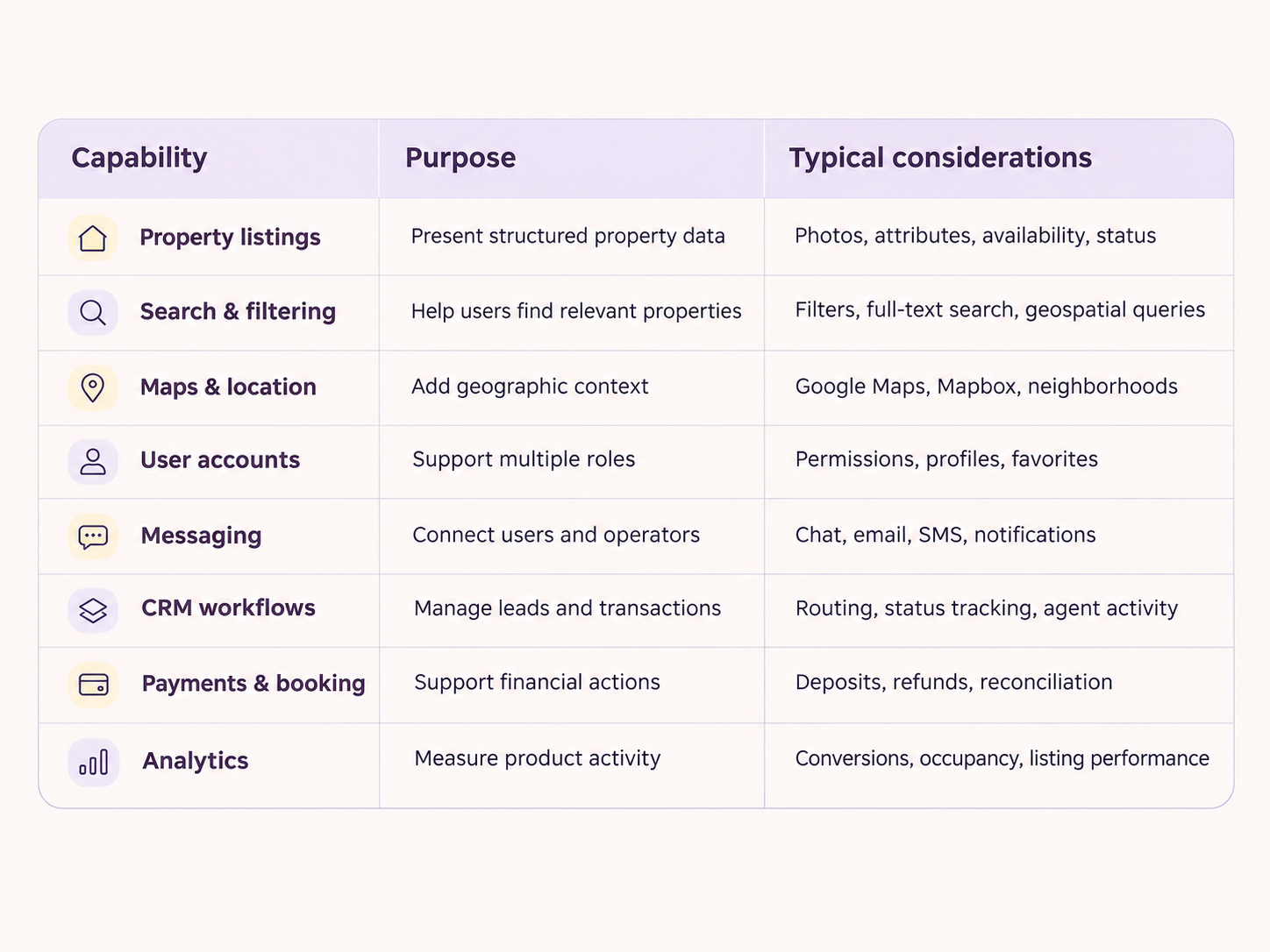
Good real estate app development services should determine what belongs in the first release and what can wait.
Architecture for Scalable Real Estate Apps
Real estate platforms are data-heavy systems where listings, search indexes, CRM records, availability, messages, and third-party feeds can all change independently, so architecture needs clear data ownership and predictable synchronization while still supporting fast filtering and responsive map interactions.
Backend services typically manage listings, users, permissions, transactions, integrations, notifications, and analytics, while dedicated search infrastructure may become necessary as inventory and filtering complexity grow. Geospatial queries require databases or search engines built for location-based operations, and caching plus background processing can help handle frequently accessed data, imports, images, notifications, and synchronization efficiently.
UppLabs' Ukrsutki case study demonstrates this type of engineering: legacy real estate software was rebuilt with improved search, multilingual support, real-time chat, Google Maps integration, data migration, and performance optimization.
Integrations Often Define Product Complexity
Real estate web application development often depends on integrations with property databases, MLS systems, CRM platforms, maps, payments, messaging, analytics, identity services, and document tools. Complexity comes from keeping those systems synchronized while maintaining reliable data and predictable product behavior.
“Integration architecture should answer one core question: which system owns the data, and what happens when that data is delayed, duplicated, or unavailable?”
Marketplace products make this especially important because listing status, availability, user actions, and transaction data may change across several connected systems at once.
UppLabs' WeOffr case study combined property transactions with Zillow integration, financial workflows, legal integrations, security controls, and scalable infrastructure.
Integration architecture should therefore be treated as a core product capability, not an implementation detail.
Real Estate Mobile App Development
Real estate mobile app development requires more than adapting a desktop interface because buyers may browse properties on the move, agents may update listings between appointments, and tenants may upload documents, pay rent, or communicate through the app.
Mobile app development for real estate can require location services, push notifications, camera access, secure storage, deep links, background synchronization, and reliable behavior on unstable networks.
Cross-platform frameworks such as React Native can reduce duplicated development when iOS and Android workflows are similar. Native development may be better when device-specific functionality or performance requirements justify separate implementations.
Choosing a real estate mobile app development company should therefore involve backend, integration, security, and product expertise not only mobile UI skills.
Where AI Adds Value
AI works best when it improves an existing high-value workflow. Real estate products can use AI for valuation, recommendations, listing generation, document processing, tenant screening, predictive maintenance, search, or portfolio analytics.
Search is one strong example. Semantic matching can complement traditional filters and rank properties based on intent instead of only exact criteria.
Property management has different AI needs. UppLabs already covers them in Property Management Software Development and Tenant Screening Software.
Architecture should leave room for AI where it creates measurable value without making every feature AI-dependent.
Real Estate App Development Cost
Real estate app development cost depends more on product scope than screen count.
Main cost drivers include:
- product type and number of user roles;
- web and mobile platforms;
- search and geospatial complexity;
- external data integrations;
- maps, payments, messaging, and real-time features;
- AI capabilities;
- infrastructure, migration, and security requirements.
Existing services can reduce cost for standard capabilities. Custom engineering should focus on workflows that differentiate the product.
HomeToro followed this logic by combining an existing foundation with custom functionality instead of rebuilding every component from scratch.
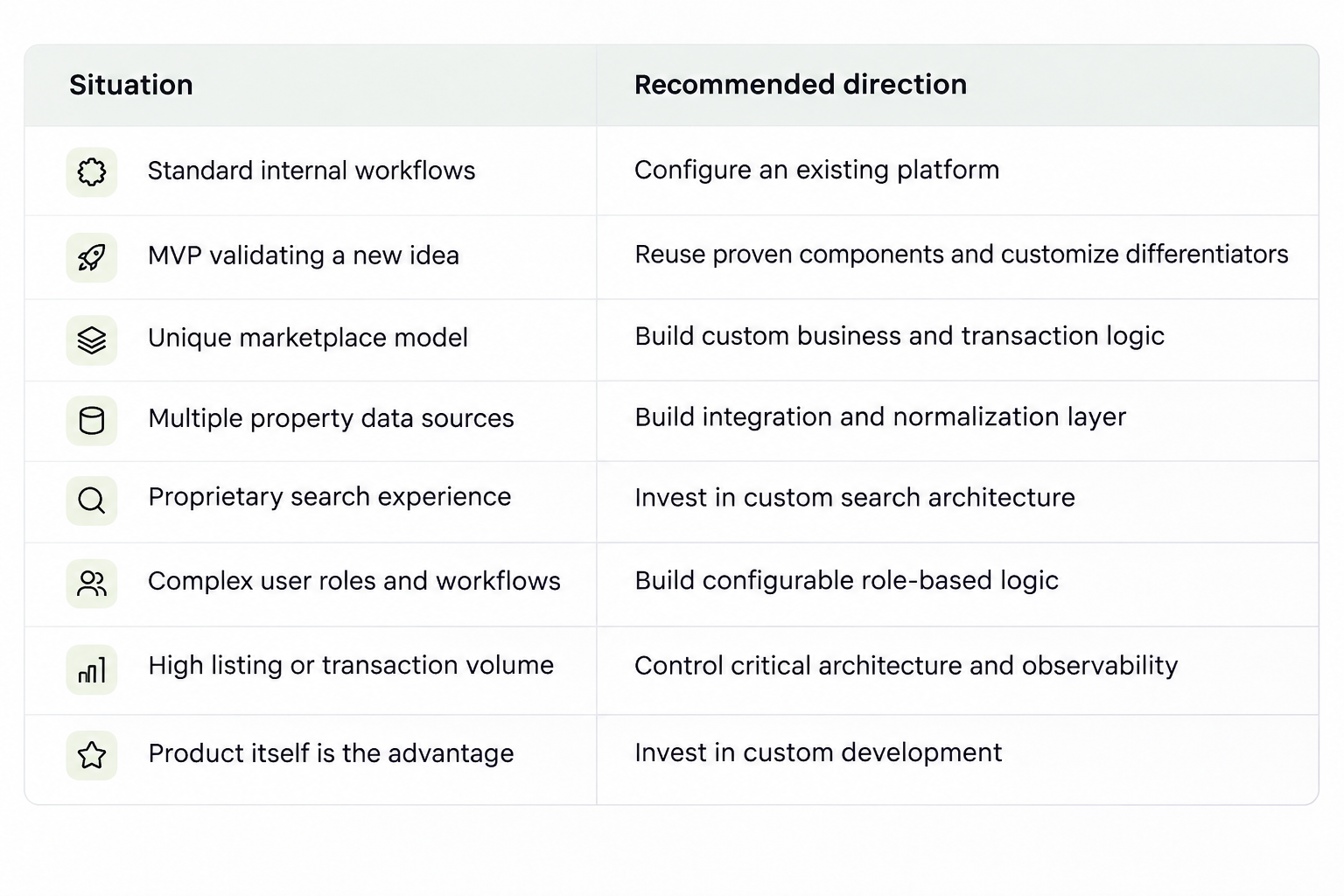
Build, Customize or Integrate?
Not every real estate product needs fully custom software.
Choosing a Real Estate App Development Company
Right real estate app development company should understand more than web or mobile development.
PropTech products combine search, geospatial data, marketplaces, transactions, integrations, property operations, and often legacy systems.
When comparing real estate app development companies, look for:
- relevant PropTech portfolio;
- scalable backend and search architecture;
- geospatial and integration expertise;
- web and mobile capabilities;
- strong QA and cloud practices;
- experience supporting products after launch.
UppLabs' PropTech portfolio includes WeOffr, HomeToro, Ukrsutki, ResiNova, and Limehome, covering marketplaces, rentals, property operations, and transaction-focused products.
When Custom Real Estate Software Makes Sense
Custom real estate software solutions make most sense when software directly affects how the business competes.
Unique search, proprietary property data, marketplace logic, automation, agent workflows, or integrations may justify deeper investment.
Standard real estate software solutions remain useful when workflows are common and differentiation comes from something outside technology.
“Question is not whether custom software is always better, but where owning the architecture creates enough business value to justify it.”
UppLabs combines PropTech expertise with Web & Mobile Development to support products from MVPs to scalable property platforms.
Final Takeaway
Real estate app development works best when architecture follows business workflows instead of feature trends.
Strong products connect listings, search, maps, communication, integrations, transactions, and operational data without making future changes increasingly difficult.
Custom development becomes especially valuable when data, marketplace logic, automation, user experience, or integrations differentiate the business.
Companies evaluating real estate app development services should start with one question: which parts of the product are standard infrastructure, and which parts create an advantage competitors cannot easily copy?
FAQ
What is real estate app development?
Real estate app development is the design and engineering of software for listings, property search, transactions, rentals, property management, agent operations, or investment workflows.
What features should a real estate app include?
Common features include listings, search, maps, user profiles, favorites, messaging, notifications, CRM integrations, analytics, and booking or transaction workflows.
How much does real estate app development cost?
Real estate app development cost depends on platforms, scope, integrations, search complexity, AI capabilities, infrastructure, and whether existing components can be reused.
What is the difference between custom and off-the-shelf real estate software?
Off-the-shelf products support standardized workflows. Custom software is designed around specific business processes, data, integrations, user roles, and product differentiation.
Should I build a web or mobile real estate app?
Choice depends on user behavior. Search, location-based experiences, notifications, and agent workflows often benefit from mobile apps, while data-heavy operational workflows may work better on the web. Many products require both.
What integrations are common in real estate applications?
Common integrations include MLS or property data providers, maps, CRM systems, payments, messaging, analytics, identity verification, and document tools.
How do I choose a real estate app development company?
Look for PropTech experience, scalable architecture skills, integration expertise, web and mobile capabilities, strong QA and cloud practices, and relevant production portfolio.
When should a company choose custom real estate app development?
Custom development makes sense when proprietary workflows, data, search, marketplace logic, automation, integrations, or user experience create competitive advantage.