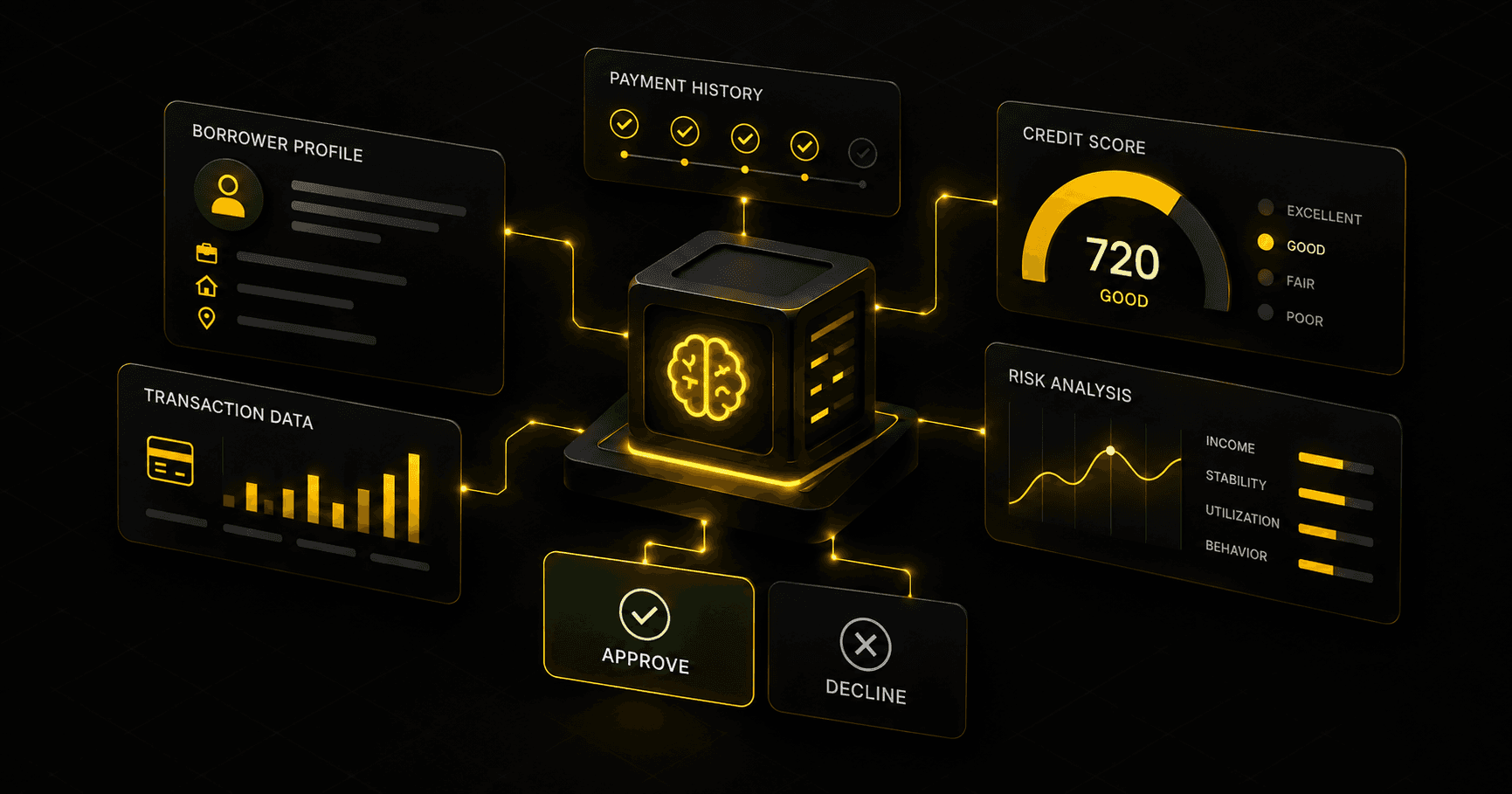
One incomplete rental history, one inconsistent income record, or one false positive in a background check can change a housing decision. Speed alone does not solve that problem.
Modern tenant screening software is moving toward a more useful goal: combine verified application data, rental history, income signals, identity checks, and predictive models into a risk assessment that property managers can understand and review. Machine learning can help identify patterns across those signals, but reliable screening still depends on data quality, model explainability, compliance controls, and human review.
For property managers and PropTech companies, the real question is no longer simply how to screen tenants properly. It is how to automate tenant screening without turning a high-impact housing decision into an opaque score.
TL;DR
- Tenant screening software combines applicant, financial, rental, identity, and background information to support rental decisions.
- AI tenant screening can add tenant risk scoring and predictive tenant scoring by analyzing patterns across multiple permitted data points instead of relying on one threshold.
- Automated tenant screening works best when verification, machine learning, policy rules, model explainability, and human review operate as one workflow.
- Tenant screening laws matter as much as model accuracy. U.S. housing providers using consumer reports must consider FCRA requirements, while Fair Housing Act obligations continue to apply when AI or machine learning is used.
- Custom systems make the most sense when screening volume is high, existing property data provides useful signals, or tenant screening must integrate deeply with property management workflows.
What Is Tenant Screening Software?
Tenant screening software helps landlords, property managers, and rental platforms collect and evaluate information about rental applicants.
Depending on the workflow, a tenant screening system may include credit information, rental history analysis, income verification, employment information, identity verification, eviction records, criminal background information, and risk scores.
CFPB guidance notes that tenant screening reports may contain credit reports, rental history, employment verification, criminal history, and risk scores or recommendations used by housing providers. Consumer Financial Protection Bureau
Traditional tools often aggregate those records and present them to a property manager. More advanced systems add tenant screening automation, verification workflows, applicant risk scoring, and machine learning models.
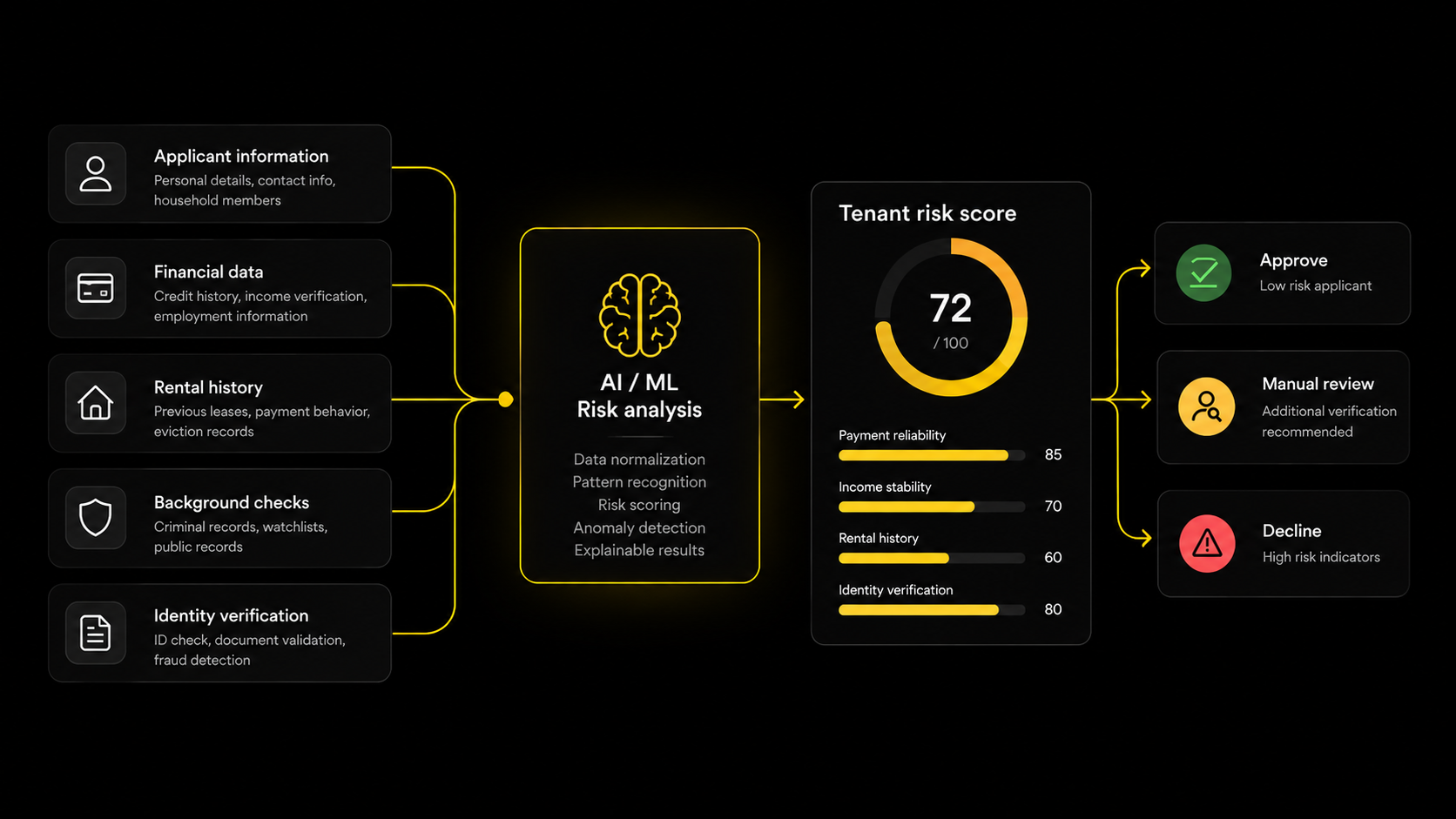
AI tenant screening adds another layer. Instead of evaluating each signal independently, a tenant screening model can look for relationships between income stability, payment history, rental behavior, account information, and other relevant inputs.
That does not mean every applicant should be automatically approved or rejected by an algorithm. Better systems use machine learning as decision support rather than treating a score as the entire decision.
UppLabs' Tenant Screening AI product, for example, is designed around predictive scoring, behavioral predictions, risk breakdowns, and lease recommendations rather than a single pass/fail result. UppLabs states that its model evaluates more than 50 data points and predicts factors such as payment behavior and lease completion likelihood.
How Machine Learning Tenant Screening Evaluates Rental Risk
Machine learning tenant screening works by converting applicant and rental data into structured features, evaluating patterns associated with different outcomes, and producing a tenant risk assessment.
Workflow design matters because rental risk assessment is not one universal metric. Property managers may care about several outcomes: on-time rent payment, likelihood of completing the lease, potential rental fraud, property-care risk, or need for additional verification.
A production workflow can look like this:
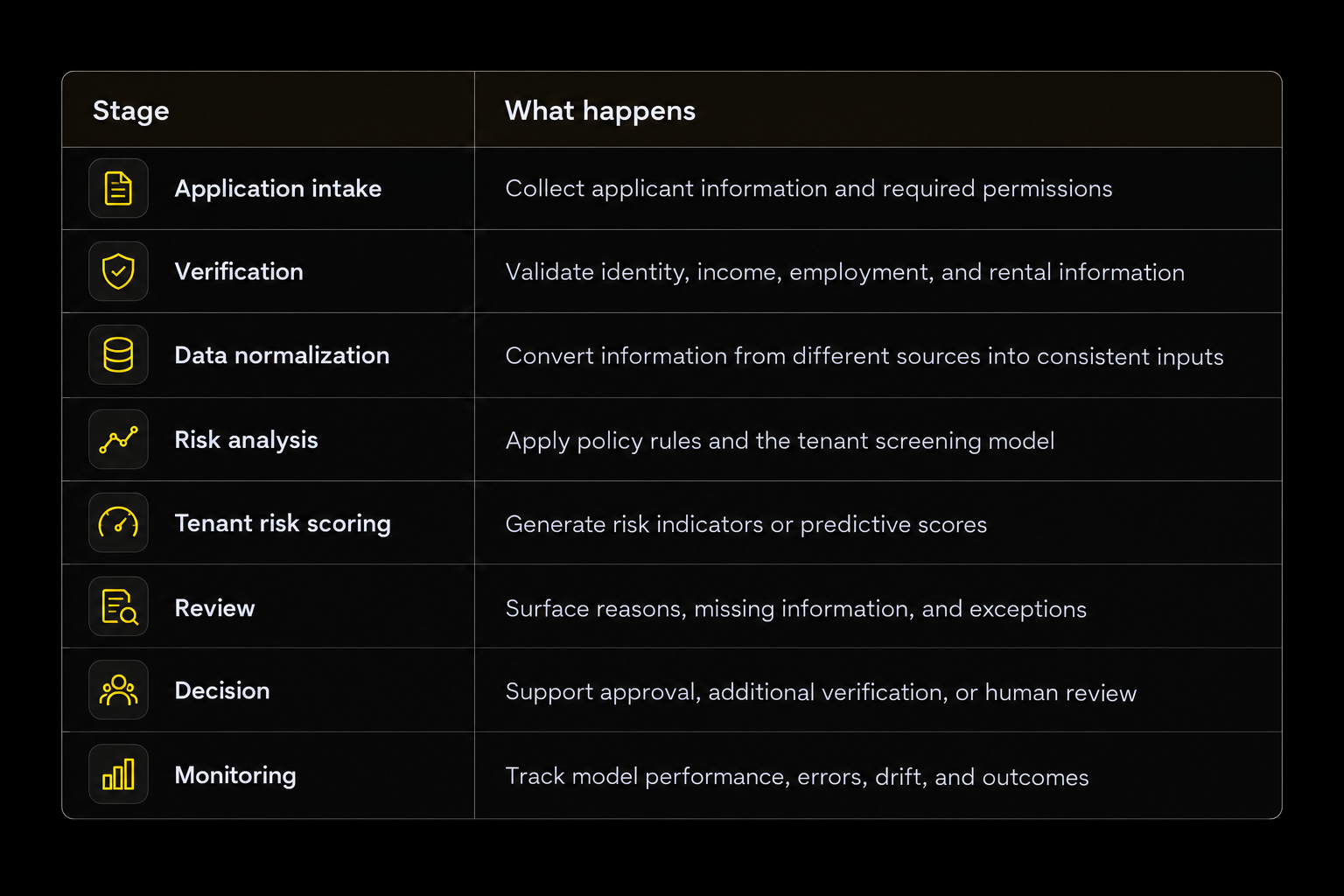
Predictive tenant scoring becomes useful when historical data contains relationships that simple thresholds miss. Income-to-rent ratio, for example, may be useful but incomplete. Employment stability, historical payment behavior, rental history, application consistency, and other permitted signals may together provide a more complete view. Machine learning does not turn those signals into certainty. It estimates patterns and probabilities. That distinction should remain visible throughout the product.
What Data Should a Tenant Screening System Evaluate?
Strong tenant screening starts with relevant, accurate, and reproducible data. Tenant credit and criminal background check information may be part of the process, but relying only on those records can create an incomplete picture. Comprehensive tenant background check workflows often combine several categories of information, depending on applicable law and screening policy.
Rental history analysis can reveal previous tenancy patterns. Income verification and employment information can help assess whether reported financial details are consistent. Identity verification helps confirm that application data belongs to the person submitting it.
Rental application data can also be checked for inconsistencies, duplicate identities, missing information, or suspicious patterns.
More data is not automatically better. Risk models should use information that has a legitimate connection to the decision, can be verified, and can be governed appropriately. Protected characteristics should not become shortcuts for predicting tenant quality.
Model design should also account for inaccurate or outdated records. CFPB has reported receiving complaints about errors in tenant screening reports, and federal law gives applicants rights to dispute inaccurate information.
Automated Tenant Screening vs. Traditional Screening
Automated tenant screening can reduce manual work, but automation alone is not the main benefit. Better value comes from creating a consistent workflow where verification, risk analysis, policy rules, and human review are connected.
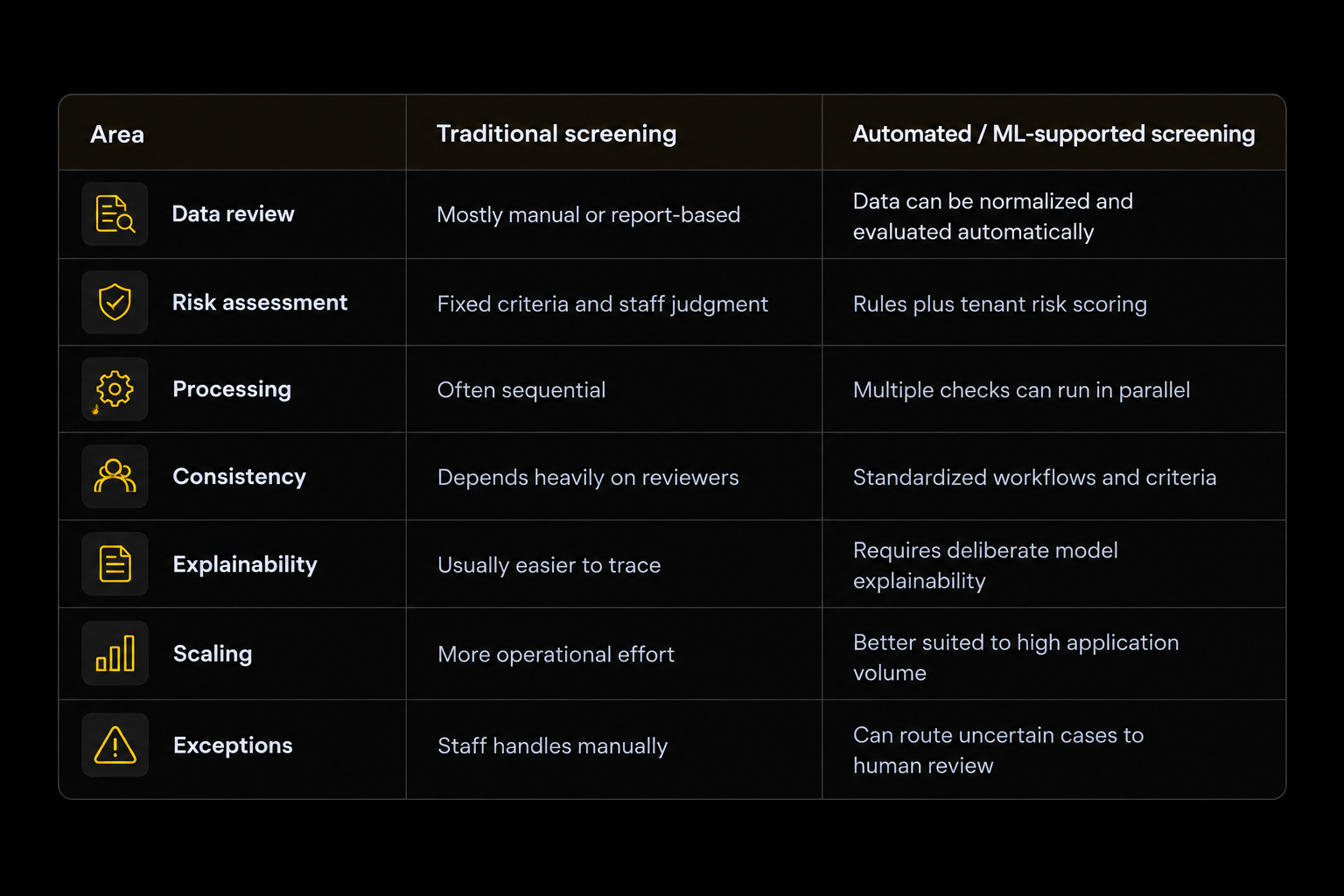
Tenant screening AI should therefore reduce repetitive processing without removing oversight. Complex cases, incomplete applications, conflicting information, or borderline scores are precisely where human review becomes valuable.
Tenant Screening API and Property Management Software Integration
Standalone screening creates another workflow problem: data has to move between the leasing system and the screening tool. Tenant screening API integration can remove that friction.
Application data can move from the leasing interface into verification and screening services. Results can then return to the property management platform with risk indicators, verification status, supporting evidence, and review requirements.
Good property management software integration should keep screening connected to the rest of the tenant lifecycle rather than creating another disconnected dashboard.
UppLabs has experience building exactly that wider PropTech infrastructure. Its Property Management Platform case study describes a platform combining property management, tenant acquisition, and financial data across more than 200,000 multifamily units, with 30,000+ active users.
Broader PropTech services from UppLabs include property management platforms, lease management, marketplace systems, analytics, and AI-powered real estate capabilities.
For teams building custom screening features, UppLabs' AI/ML Development service also covers full ML pipelines from data ingestion and feature engineering through deployment, monitoring, drift detection, and retraining.
Model Explainability Matters in Rental Decisions
Predictive accuracy is not enough for a high-impact decision. Property managers need to understand why a tenant screening model produced a certain result, which signals influenced it, and where uncertainty remains.
Model explainability can support that process by surfacing meaningful factors instead of presenting a black-box number. Example output might show that income verification is complete, rental history is stable, but identity data requires another check. Another applicant might have a strong financial profile but conflicting application information.
Such explanations are more actionable than a score alone. Explainable tenant screening also makes it easier to identify errors and investigate tenant screening bias.
HUD's 2024 guidance states that the Fair Housing Act applies to tenant screening that uses machine learning and other forms of AI. Guidance recommends greater interpretability, evaluation of model data, testing for disparate outcomes, and consideration of less discriminatory alternatives when appropriate.
Human review remains important because models cannot resolve every context correctly. Goal should be consistent decision support, not automated certainty.
Tenant Screening Laws and FCRA Compliance
Compliance cannot be added after the model is deployed. U.S. tenant screening laws involve several layers, including the Fair Credit Reporting Act and Fair Housing Act, plus potentially applicable state and local requirements.
FTC guidance explains that tenant background reports used by landlords are consumer reports under the FCRA. Reports can include rental history, criminal history, credit information, or a risk score and recommendation. Federal Trade Commission
FCRA background check for tenants requirements become particularly important when information from a consumer report affects an adverse decision.
Adverse action is broader than simply denying an application. FTC guidance includes examples such as requiring a co-signer, charging higher rent, or requiring a larger security deposit. When a consumer report influences such a decision, the landlord must provide an adverse action notice containing required information about the reporting agency and the applicant's dispute rights.
Tenant screening compliance should therefore be part of product architecture. Systems may need to retain decision inputs, record which report influenced the outcome, support audit trails, surface the appropriate disclosures, and allow staff to review disputed information. Compliance requirements vary by jurisdiction and use case, so legal teams should define the applicable rules before those workflows are automated.
How to Screen Tenants Properly With Machine Learning
Better screening does not start with choosing an algorithm. Workflow should begin with the decision and then work backward to the data, model, policies, and controls needed to support it.
For property managers evaluating how to screen tenant applications at scale, five principles are especially useful:
- Define which rental risks need to be evaluated and which decisions the software is allowed to support.
- Verify applicant information before using it as a model feature.
- Separate predictive tenant scoring from final policy and approval logic.
- Keep explanations, exceptions, and human review available for uncertain or high-impact cases.
- Monitor accuracy, bias, applicant disputes, and real-world tenancy outcomes after deployment.
UppLabs' existing PropTech work demonstrates this broader product approach. Its AI-powered property management case study combines tenant screening with lease management and predictive maintenance instead of treating screening as an isolated feature. That architecture matters because screening is only the beginning of the tenant lifecycle.
Decision Framework: Do You Need Custom Tenant Screening Software?
Before building or integrating tenant screening software, answer these questions:
- How many rental applications must the platform process, and how quickly?
- Which verification and screening sources are already available?
- Does proprietary rental or property data provide useful predictive signals?
- Should the tenant screening system recommend decisions or automate specific low-risk steps?
- Which cases must always go to human review?
- What explanations and records must be available when a decision is challenged?
- How will the model be monitored for performance changes and tenant screening bias?
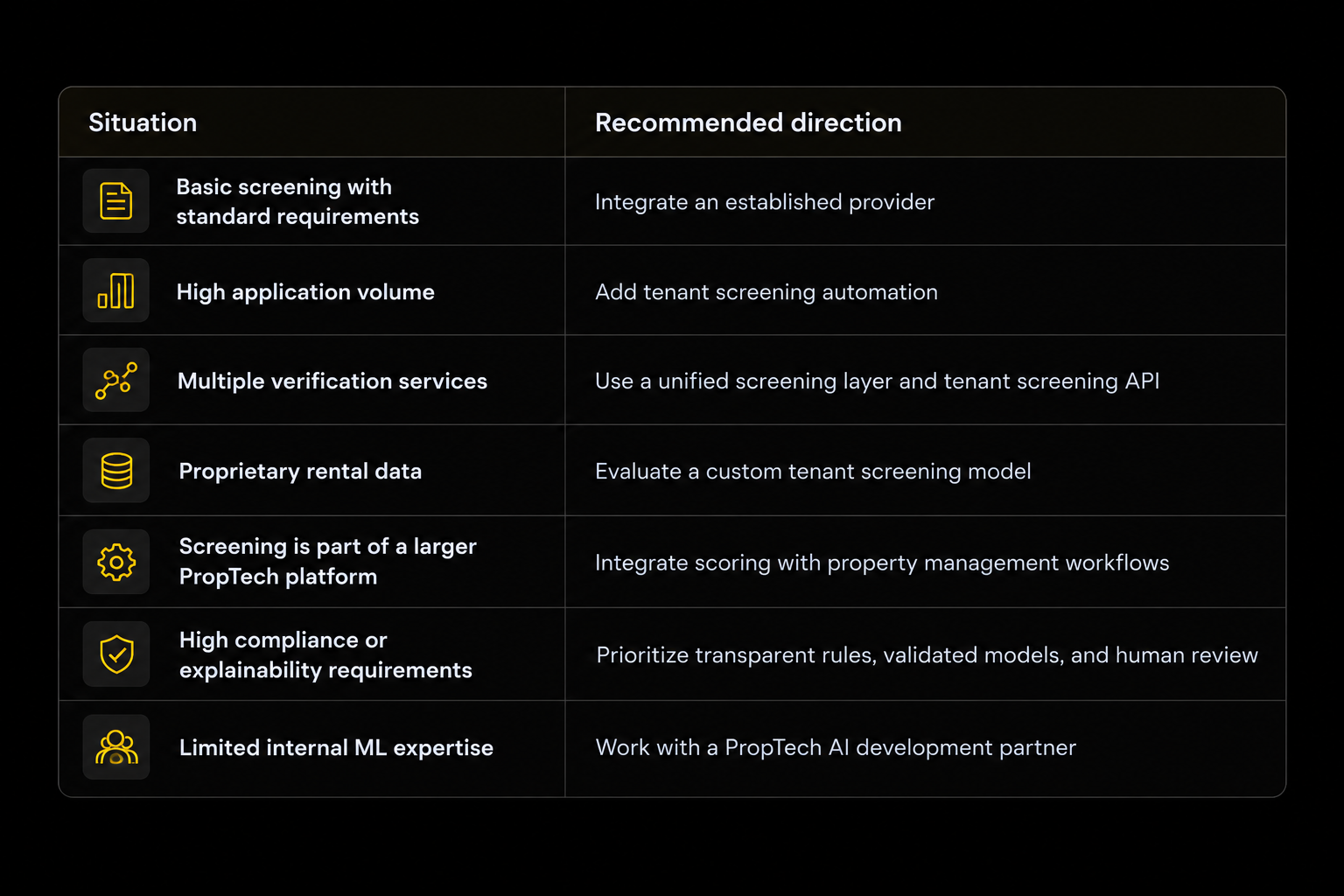
Answers determine whether an existing screening provider is enough or whether a custom workflow provides meaningful value.
When Custom Tenant Screening Makes Sense
Existing tools work well when requirements are standard and screening is not a differentiating product capability.
Custom development becomes more relevant when rental operators manage large portfolios, combine several data providers, need applicant risk scoring tailored to their workflow, or want screening to work directly inside a broader property management product.
UppLabs develops AI-powered PropTech products across property management, valuation, marketplaces, and tenant workflows. Its PropTech AI offering includes tenant screening alongside automated application processing and wider lease-management functionality.
Tenant Screening AI from UppLabs also demonstrates how predictive scoring, behavioral indicators, risk factors, and recommended actions can be presented together rather than reduced to a single opaque number. Custom implementation should still begin with data feasibility. Weak or biased data cannot be fixed simply by using a more sophisticated model.
Build Tenant Screening Around the Decision
Tenant screening software creates the most value when it improves both speed and decision quality. Machine learning can support rental risk assessment, predictive tenant scoring, identity and income verification, and application prioritization. Reliable implementation still requires accurate data, explainable models, policy controls, tenant screening compliance, and human oversight.
Property managers do not need another score they cannot interpret. They need a screening workflow that helps them understand risk, verify information, handle exceptions, and make consistent decisions at scale.
UppLabs builds custom PropTech and AI systems around those workflows, from ML models and APIs to complete property management platforms. Explore UppLabs' PropTech Software Development services, AI/ML Development capabilities, Tenant Screening AI product, and Property Management Platform case study to see how screening can fit into a broader real estate technology stack.
FAQ
What Is Tenant Screening Software?
Tenant screening software helps property managers evaluate rental applications by collecting and organizing information such as identity, income, rental history, credit data, background information, and risk indicators.
What Is AI Tenant Screening?
AI tenant screening uses machine learning or related analytical methods to identify patterns in applicant data and support tenant risk assessment. Strong systems combine predictive models with rules, verification, explainability, and human review.
How Does Machine Learning Evaluate Rental Risk?
Machine learning tenant screening converts applicant information into structured features and compares those patterns with historical outcomes. Model output may include a tenant risk score, prediction, or set of risk indicators rather than a simple approval or rejection.
What Is a Tenant Screening API?
Tenant screening API allows another application, such as a leasing portal or property management system, to send applicant data to screening or verification services and receive structured results without requiring staff to move data manually between platforms.
Can Tenant Screening Be Fully Automated?
Some administrative steps can be automated, including data collection, verification requests, normalization, and routing. High-impact or uncertain decisions benefit from human review, especially when information is incomplete, disputed, or difficult to interpret.
How Can Property Managers Reduce Tenant Screening Bias?
Consistent screening criteria, accurate data, model testing, explainability, monitoring, and human review can reduce risk. Teams should also evaluate applicable fair-housing and consumer-reporting requirements when designing automated workflows.
What Should Tenant Screening Software Integrate With?
Common integrations include rental applications, identity and income verification, consumer reporting services, leasing workflows, applicant communications, and property management software. Integration design should keep screening results connected to the complete leasing process rather than isolated in a separate tool.